Water is a precious resource in Spain. Along the Camino we become very aware of its value and the many sources of water. In some places, fast moving rivers are used for generating power and in other areas elaborate aquaduct and canal systems deliver water for farmers to irrigate their crops. We have walked for vast distances alongside raised stone or concrete aquaducts which can be accessed by farmers who pay a form of tax to divert water for their fields. The ancient systems work surprizingly well and the modern systems involving pipe and pumps seem to involve so much more manpower and often have problems . Along the rivers in Galicia there are small sluice gates which can be raised - again for a fee, diverting a small quantity of water for the farmer. He is given a key and the regulations are very strict so there is less abuse. On Saturday I arrived in Portomarin, a town that was moved in the 1960´s when a dam was built on the Mino to create a huge water reservoir. The town was rebuilt higher up above the reservoir and the views from our alberque reminded me of a small lake in Ontario. We have not seen any lakes, only rivers and with the very hot weather we´re experiencing right now one wonders if some of the rivers will dry up during the summer. Today´s journey crossed over six rivers making for a few kms of cooler, shady paths - part of the way we passed through groves of huge eucalyptus trees. The fragrance was almost intoxicating but we aren´t sure how the wood is used - perhaps for furniture?
There have been several places in northern Spain where the power of wind is being harnessed by huge wind turbines. They are often a strong contrast to the natural beauty of the hills and mountains and disliked by many people. When the Camino passed close to a long row of these turbines we could hear the power of the blades above us. The area was so windy it was nearly impossible to walk against the force of the wind. Although the turbines do intrude on the landscape there is a type of beauty in the simple design and it´s satisfying to know that a form of alternate energy is in use.
Of course the sun is a powerful force in Spain. Despite the warnings that spring might bring rain we have had almost constant sunny, hot weather. Again there have been numerous examples of the use of alternate energy with solar panels on private homes and even on some public buildings. It is because of the sun that the siesta is very much a part of Spanish life. The mornings and evenings are much cooler and people take two hours a day off from work to rest - businesses are closed from 2 o´clock to 4 o´clock but it can vary from town to town. Every home and establishment has metal or wooden blinds that screen out all the sun during the hottest part of the day. Unfortunately for pilgrims it can give the impression that a town or village is shut against us or deserted if we pass through in siesta! We are somewhat out of sinc with ordinary Spanish culture. Most of us rise at 5 or 6am are on the Camino by 7am and stop for the day in the middle of siesta. We are hungry for dinner a good two hours before the locals eat their dinner and need to be in bed between 9 and 10pm! It all makes for an interesting exercise in adaptation! How will we adjust back to our normal lives?
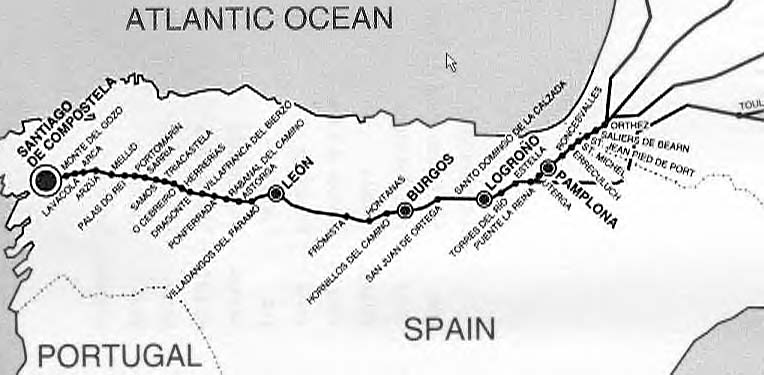
The beginning of the journey
St Jean Pied de Port
The destination

Cathedral in Santiago

Subscribe to:
Post Comments (Atom)

Hi Gill,
ReplyDeleteI am so enjoying reading your blogs. I especially like the way you've chosen themes to guide your writing rather than just a step by step story of your day.
You give us such a lovely clear picture of the land and its people.
I salute you!
Fran