
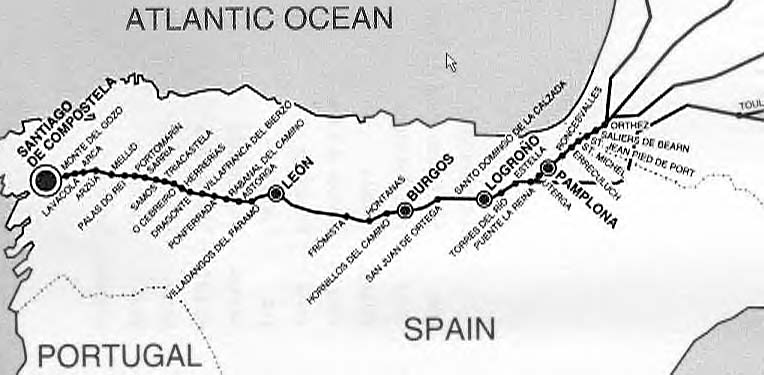
It's hard to believe it's only been a week since I started the Camino. Fran leaves tomorrow for Madrid to meet Dan and I will really miss her. Tonight we are relaxing with friends Karen and Adrianna after covering over 150km on the way to Santiago. We are in Viana, a beautiful city dominated by two beautiful churches ( I wish I could upload photos but it doesn´t seem possible from these remote locations.)
The last few days have been sunny and warm and the countryside very hilly with vineyards and olive groves as far as the eye can see. Everyone on the Camino is suffering various injuries such as foot blisters, heat rash, shin splints and sore muscles. Each afternoon when we stop for the day people can be seen helping each other with bandages, blister kits and back rubs. The relief one feels when there's a bed available at the albergue is incredible! We bunk in (men and women, young and old all in the same space). In some locations we have enjoyed outdoor clotheslines and a sunny patio to sit while the laundry dries. Every day socks and underwear have to be washed - most people have only one change of clothes and it's important to change socks during the day to avoid blisters.
All the senses are stimulated on the Camino. We have seen beautiful views, smelled fragrent spring flowers, heard the songs of thousands of birds and tasted wonderful food. Everything tastes amazing when you have walked miles and stop for a break. A piece of local cheese with a hunk of bread finished off with fresh spring water becomes a meal for the gods! In some towns a pilgrims meal is offered early and includes local wine. No matter how simple the fare we are grateful - restaurants in Spain serve dinner very late and we need to be in bed between 9 and 10 o´clock.
This part of Spain has many ancient villages with the churches visible for miles. The ones we have visited have been mostly in the Romanesque style, with simple lines and very solid construction. Pilgrims are treated well - often there is a pigrim mass in the early evening and villagers call out "buen camino" as we pass. It is interesting how the siesta is so much a part of Spanish culture. If we pass though a village between the hours of 2 and 4 o´clock everything is closed, shutters are closed and the streets are deserted except for the pilgrims hobbling through!
After 4 o´clock everything comes to life, workers are back on the job and we can buy supplies as shop doors are opened again! Finally after a week we understand the routine and work around it!
Part of the charm of the Camino is that you become more connected than you would as a tourist - even with limited language skills we seem to be understood and treated with kindness. That is remarkable considering what a rag-tag bunch we are on the trail.
The last few days have been sunny and warm and the countryside very hilly with vineyards and olive groves as far as the eye can see. Everyone on the Camino is suffering various injuries such as foot blisters, heat rash, shin splints and sore muscles. Each afternoon when we stop for the day people can be seen helping each other with bandages, blister kits and back rubs. The relief one feels when there's a bed available at the albergue is incredible! We bunk in (men and women, young and old all in the same space). In some locations we have enjoyed outdoor clotheslines and a sunny patio to sit while the laundry dries. Every day socks and underwear have to be washed - most people have only one change of clothes and it's important to change socks during the day to avoid blisters.
All the senses are stimulated on the Camino. We have seen beautiful views, smelled fragrent spring flowers, heard the songs of thousands of birds and tasted wonderful food. Everything tastes amazing when you have walked miles and stop for a break. A piece of local cheese with a hunk of bread finished off with fresh spring water becomes a meal for the gods! In some towns a pilgrims meal is offered early and includes local wine. No matter how simple the fare we are grateful - restaurants in Spain serve dinner very late and we need to be in bed between 9 and 10 o´clock.
This part of Spain has many ancient villages with the churches visible for miles. The ones we have visited have been mostly in the Romanesque style, with simple lines and very solid construction. Pilgrims are treated well - often there is a pigrim mass in the early evening and villagers call out "buen camino" as we pass. It is interesting how the siesta is so much a part of Spanish culture. If we pass though a village between the hours of 2 and 4 o´clock everything is closed, shutters are closed and the streets are deserted except for the pilgrims hobbling through!
After 4 o´clock everything comes to life, workers are back on the job and we can buy supplies as shop doors are opened again! Finally after a week we understand the routine and work around it!
Part of the charm of the Camino is that you become more connected than you would as a tourist - even with limited language skills we seem to be understood and treated with kindness. That is remarkable considering what a rag-tag bunch we are on the trail.



Hi Gillian:
ReplyDeleteYou write eloquently about your experiences - it certainly takes me back to my walk. Do you hear a cuckoo each morning as you start your walk? A cafe con leche doesn't taste the same in Toronto.
Darlene